“At the heart of Catholic education lies the Christian vision of the human person. This vision is expressed and explored in religious education. Therefore, religious education is never simply one subject among many, but the foundation of the entire educational process.” (Catholic Bishops’ Conference of England and Wales, 2000).
In a Catholic school, Religious Education is ‘the core of the core curriculum’ (Pope St John Paul II), not only as an academic subject but as a vital part of the Church’s mission to make Christ known to all people. Rooted in the Gospel and the teachings of the Catholic Church, RE supports the spiritual, moral and intellectual formation of young people, preparing them to live out their faith with wisdom, compassion and integrity, remembering that we have both our origin and our destination in God.
RE in our school plays a central role in supporting parents, the primary educators, in the religious formation of their children, while also fostering meaningful links between the home, the parish, and the wider diocesan community. It serves both the Church and society by promoting values of truth, justice, respect, and love, and by equipping pupils to engage thoughtfully with the world around them.
RE also fosters skills of critical thinking, philosophical enquiry, and ethical reasoning, helping pupils to engage with life’s ultimate questions and to discern their place and purpose in God’s creation. Through our carefully planned five-year curriculum, pupils will:
- Explore the life, teachings, and mission of Jesus Christ, the history and development of the Catholic Church, and how faith is lived out through worship, prayer, and moral action.
- Reflect critically and respectfully on their own beliefs and those of others, including those from other world religions such as Judaism, Islam, and Sikhism, as well as those with no religious belief. This nurtures a deep empathy and understanding, in line with Gospel values of inclusion, dialogue, and love of neighbour.
- Analyse why people believe in God, how belief affects behaviour, and how religion has profoundly shaped culture, literature, and art, enriching their understanding of both faith and human experience.
Ultimately, Religious Education in our Catholic school forms pupils who are spiritually aware, morally responsible, and intellectually curious. It inspires them to live out their faith in service to others, to stand for truth and justice, and to recognise the sacred in themselves, in others, and in the world around them, just as Christ taught us.
If a parent chooses to withdraw their child from RE they will need to arrange a meeting with Mrs Terri Rosa, Deputy Head Teacher, to discuss this.
Head of Department: Mrs. M. Wallbank (maternity leave)
Acting Head of Department: Mr R Collins
Exam Board: Eduqas
Religious Education at St Patrick’s
Rooted in faith, sent out in mission
St Patrick was a young man taken far from home who discovered in hardship a faith that would shape the rest of his life. He returned freely to the people who had enslaved him, bringing them the Gospel with courage, humility and forgiveness. Religious Education at St Patrick’s is shaped by his example. We want our pupils to know their faith deeply, to live it with confidence, and to carry it into the world as he did.
As a Catholic school in the Diocese of Salford, we follow the Diocesan Religious Education Curriculum Directory (RECD). RE sits at the heart of our curriculum. Through it, pupils come to appreciate the richness of Catholic education and are drawn into a deeper relationship with Christ and his Church.
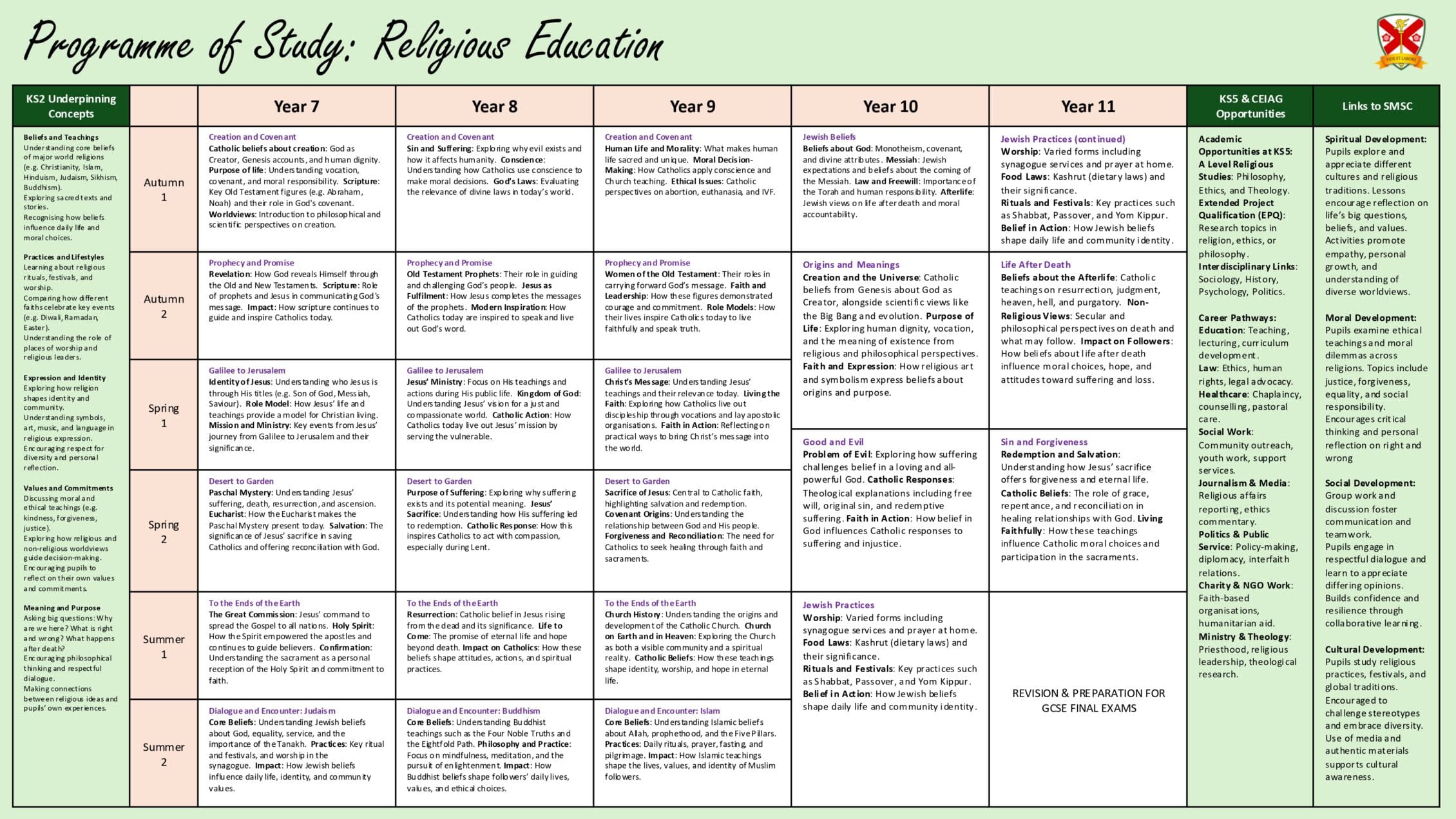
Our Curriculum: Key Stage 3
The new RECD has been fully in place since September 2025. It follows a spiral structure: pupils return to key ideas at greater depth as they move through the school. Learning is grounded in Scripture and lived experience, and follows the rhythm of the liturgical year. Our scheme of work is organised into six half-term branches:
- Creation and Covenant
- Prophecy and Promise
- Galilee to Jerusalem
- Desert to Garden
- To the Ends of the Earth
- Branch 6: Dialogue and Encounter (the study of world religions)
Like St Patrick, who came to know God through the story of salvation, our pupils journey through that story from creation to the mission of the early Church. To the Ends of the Earth has a special resonance at St Patrick’s: Patrick answered the call to take the Gospel to the edge of the known world, and we invite pupils to ask how they are called to be missionary disciples today.
Our KS3 scheme of work meets all the requirements of the RECD. Key themes recur and deepen over time, including the Golden Rule, Catholic Social Teaching and the sanctity of life. Major feasts such as Christmas and Easter are taught as they fall in the Church’s year, so that classroom learning and the prayer life of the school support each other. This firm foundation prepares pupils well for study at KS4.
High Expectations and a Voice for Justice
Our curriculum is ambitious and challenging, and we set high expectations for every pupil. We bring current world events into lessons so that pupils stay informed and can apply their faith to real situations. St Patrick spoke out against injustice and cruelty, even at personal cost. We want our pupils to do the same: to recognise ignorance and injustice and to have the knowledge, courage and moral conviction to challenge it.
Key Stage 4
Because RE is the core of the core, every pupil studies for a full GCSE in Religious Studies. We are an inclusive department and make sure every learner is supported to succeed. We follow the Eduqas Route B specification, which is rooted in Catholic Christianity, with Judaism as our second religion in line with Diocesan guidance. Pupils learn to debate, discuss and analyse moral and ethical questions, Church teaching, and the shared Abrahamic heritage of Judaism and Christianity.
Growing in Faith
RE at St Patrick’s is a place where young people can flourish. Their questions and opinions are welcomed, and their voices are heard. In the words of St Patrick’s Breastplate, “Christ beside me, Christ before me, Christ behind me.” Our hope is that every pupil leaves us knowing that Christ walks with them, and ready to share that faith with others.
On This Page